Wednesday, 30 April 2008

Mhmm, Food

Original Posting date: Friday October 19th 2007


Well, most people probably already now that you can get nearly everything here, but only a few know how good and even cheap the stuff is!
But let's start at the beginning: The shops.

Most shops don't open until 11.00 am (some at 10.00, some at 1.00 pm) but accordingly they don't close until 8.00 pm or 10.00 pm either. And I mean real stores, ones which carry electronics, garment etc.

Super Markets open up in the morning and are open till 9.00 pm or sometimes 11.45 pm. And then there's the Konbini (from English convenient). Those things are open 24 hours a day, nearly 365 days a year and offer a wide range of products, primarily of course food and beverages but also a variety of things you find in a drug store.

What's irritating in the beginning is the scream that welcomes you when you enter a shop. As soon as a store clerk sees a customer or one steps into the store he says "いらっしゃいませ" irasshaimase to the customer, which is kind of a real heartful "Welcome" in a very polite (grammar) form and by saying I mean that sometimes they downright scream it at you, so that you notice it no matter what.
Helmut told me that in Tokyo it's not that common anymore to say it in a real hearty but here in the Kansai region it's everyday's practice (mannerless, impolite Tokyo people, hrm).
Since we're already talking about sentences from store clerks: If you're buying something and are about to pay, the vendor doesn't only tell you what it costs (it's displayed on the machine anyway), but they also tell you how much money you've given him. e.g. "It's 365 Yen *give money*; 1000 Yen, 635 Yen change." Although it gets worse with this: They ask you if you need an additional bag, if you want chopsticks, if you want special food already warmed up in the microwave of the shop, if you have a point card etc. Actually very nice, but these are studied set phrases and they mumble it in such a speed so that you understand exactly nothing at all.

What's nice in my opinion is the fact, that they address you not simply with "Sir" or "Thou" (edit: In German we use a polite form not a simple "you" when talking to strangers, it can be compared to French and their use of "Vous"), on the contrary, in Japan it's considered to be impolite to address someone with "Sir" or "Thou" (anata) if you know the name or the social status of that person. Therefore the name you by the status you're adopting at the given moment, which means in stores you are the Okyakusama; the "Highly worshipped customer".

And now something for people, who like good things to be cheap (which includes me). Starting around 7.00 pm the super markets are starting to gradually decrease the prices for things they don't want to sell anymore the next day, primarily fish and meat (which, of course, is the Fish that came in on that day, so it's fresh). And not later than 8.30 pm you can get all these things for half price.
A big piece of raw salmon for 2 Euro? Give it to me! A bowl of octopus for 1.50 Euro? Absolutely! and so on.
The best thing though? Nearly everything is ready to be eaten on the spot.

So, here's my tip: If you ever happen to be in Japan, want it cheap and don't mind to eat a little bit later in the evening (edit: In middle Europe the main dish is lunch) storm the next super market!


And now for the actual title of this entry -- food:

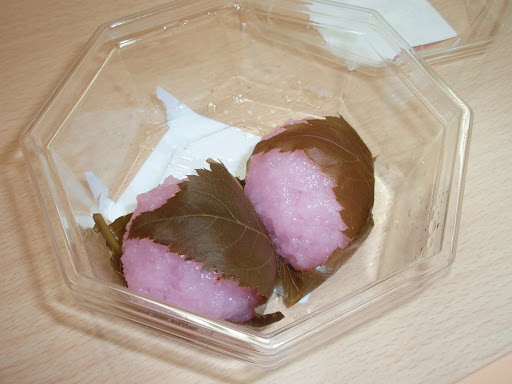
Maybe now some people may finally don't bother me anymore: Mochi (Sweets variant)


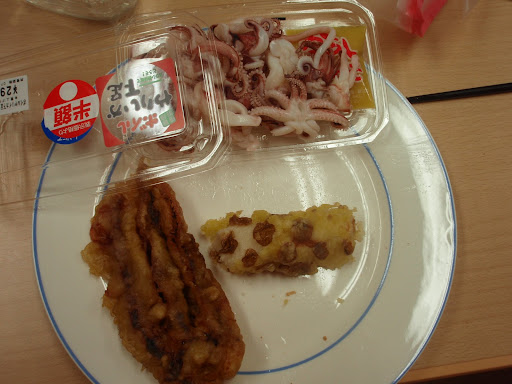
My dinner yesterday: Fried squid arm ("Ika", on the right), Fried octopus tentacle ("Tako", on the left) and Baby-Squids


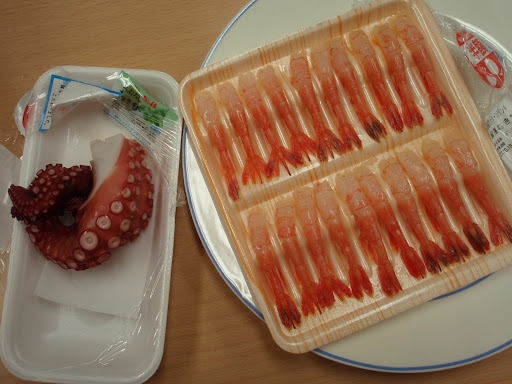
My dinner today: Ebi (shrimps) and a big octopus tentacle, unbelievable good.


And if there are any prejudices versus cephalopods; in Korea sometimes those things are eaten alive and then the tentacles are still picking around your face while eating. (Anyone who has seen the Korean film "Oldboy" knows what I mean, although in reality they're doing it in a more elegant way)


Interesting (and funny) facts/opinions about Japan:

Japanese people eat many things (above all noodle dishes) not only really fast but also boiling hot, because their opinion is that the dishes taste best that way. To manage doing this, they suck in air while eating to not burn themselves, which results in a very loud slurping. In Austria this would be considered as extremely impolite and very bad eating manners but here even business people in restaurants use this technique.
The Western person waits until his soup has cooled down or blows on it und is smiled compassionate at.

The interesting fact is that in earlier times it was courteous in Middle and Western Europe too to pleasuable slurp your soup. Even Knigge (edit: A famous German expert on manners) disadvised people from blowing onto the soup on your spoon, rather wait a little bit before starting to eat.

Monday, 14 April 2008

Views of all kind

Original posting date: Thursday, October 11th 2007


Well, University life is really getting exhausting now, therefore my entries will be getting more scarce in the future.

Speaking about Uni: There are several Campus here, e.g. on the main area are three.

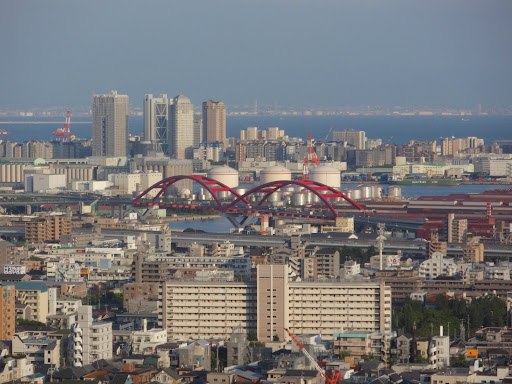
The view from the lowest point, where the International Student Center is located.


From the Intercultural Studies Campus, at middle level.


And outside the Business Administration Faculty, one of the virtually highest points of the main area.

On the right side you can slightly see a little off the bay island.


Additionally there exist three more Campus, which are partly very far away from the main Campus, among them the Fukae is especially nice because it houses the faculty for Maritime Sciences, outfitted with a modern trainingsship and sailing courses amongst others on a beautiful three-master (if I'm not mistaken).

The University of Kobe also houses the main department of the EU-Institut Japan, Kansai; for studies concerning the EU, but sadly I cannot study there.


Now, Kobe has more to offer than just studying, therefore, now to something which might be particularly interesting for the Ladies: Shopping

There are several interesting Shopping centers around: For example Sannomiya-Center, but I especially like Harbor-Land. Shopping is crazy, for all the things they have. e.g. A sportsstore, which reserves 100 x 20 meters (at least) just for Sports shoes for different occasions (Walking shoes, Town shoes etc.) and everything's not expensive at all.
Also, different cultural events take place, this week a big Biwa-contest (a kind of 4 string Japanese lute) was hosted, it was really wonderful.
Besides, they have an amusement park, an Arcade and of course the Promised Land as foretold in the prophecies of the holy book ...
Sweets Harbor

On nearly a whole floor everything is filled with sweets, chocolate, cakes, icecream and more, in various designs and themes ... alas, just take a look at the pictures (these are from the summer and some are from David).


Interesting (and funny) facts/opinions about Japan:

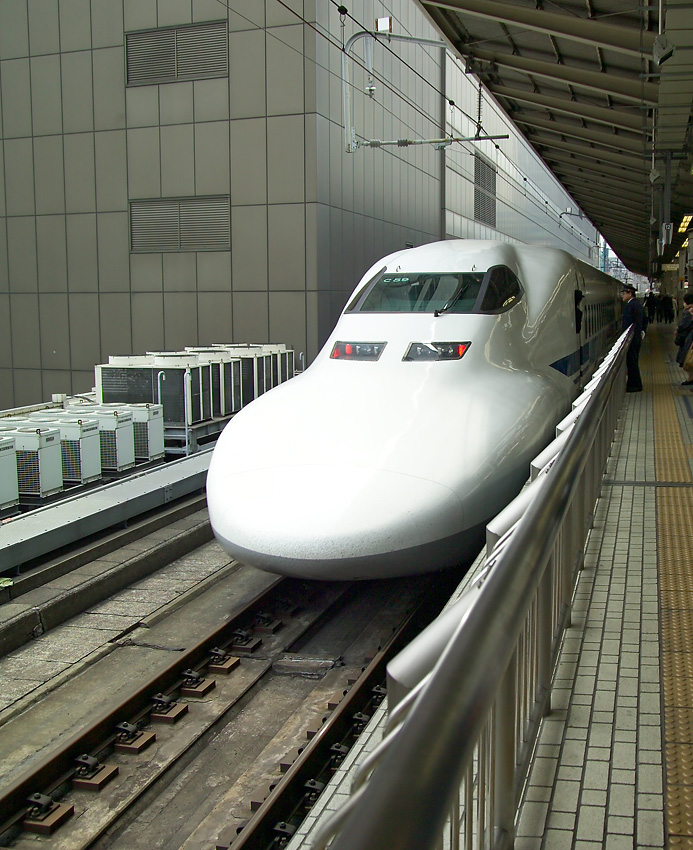
The centrepiece of the Japanese trainsystem is the Shinkansen (新幹線). The bullet train, which runs through Japan since 1964 (Opening of the Olympic Games) and which I fell in love with ;)


It runs with a speed of a little bit over 200 km/H (including stops at the stations), inside it looks like a plane but with two to three times the space for the legs and it's really quiet. Like a friend (Helmut) put it to the point: You travel like a King.
The Shinkansen is ALWAYS on time, even if you travel for three hours it arrives to the minute and in 40 years only one derailing happened, which occured during an earthquake, and even then never a fatality.
Wikipedia knows more


Japanese people have a super power: Sleeping on the train, but always waking up right at their station.
Behaviours: The absolut worst thing you can do on a train is ... to telephone! It is considered to be extremely impolite. Lindi and me (the girl from Graz, who was also member of the summer programm) have experienced it onced on a train from Yokohama to Tokyo: A man got on the train while phoning and at once all people gave him the "evil eye" but without saying a word. After he was finished he took quite an ashamed look around just that he didn't bow and apologized.
According to this the silent mode of a mobil phone is called "Manner Mode".

The whole thing has another nice side effect: Not only aren't you forced to overhear someone talking on his phone, no, you also don't hear pubescent children trying out their newest ringtones or someone listing to loud music, at a volume that you hear every note even three tiers further away.

Sometimes the extreme strictness and conformity of Japanese society has its benefits as well!

Daily Life begins

Original Posting Date: Monday, October 8th 2007


I am back at University!

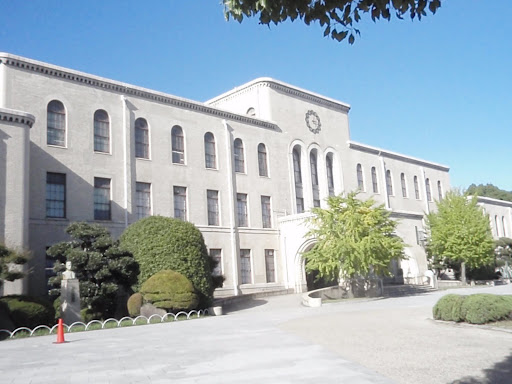
Last Friday I had a course for the first time (2 units a 1 1/2 hours) at the Faculty of Business Administration. I'm actually enrolled at the Faculty for Intercultural Studies (or: Cross-Cultural Studies), but thank Heavens with this I can study at all faculties. The University goes back to the foundation of the "Higher School for merchant business", which makes it the second-oldest Japanese University, while the BA faculty is the oldest part and core of the University. Above that, their faculty was the first higher school for commerce and business.

Yep, I'm a little bit proud to be able to study here, not to mention with a scholarship from the Japanese state (JASSO).


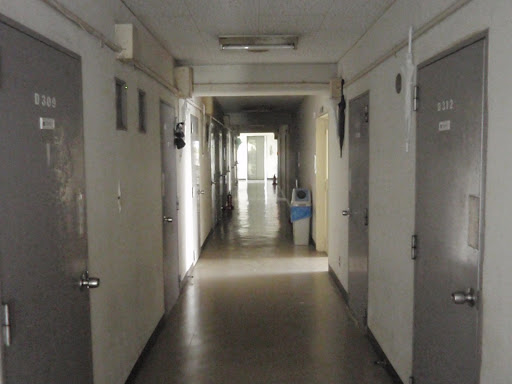
I'm living in the International Residence (which is particularly for foreign students) of the University on Port Island (one of the two man-made islands in the bay). Though I can't really shake the feeling (and I'm not the only one) that this is somehow like some kind of shipping the unloved foreigners far away from the city. If you take a look at the halls of the student home, it reminds on a prison ... also take in account the three community showers and the community toilet on each floor. The rooms are okay though, and my room here is even bigger than the one back in Graz!
Converted to Euro, it costs only 33 Euro (exclusive) per month. *thumbs up*


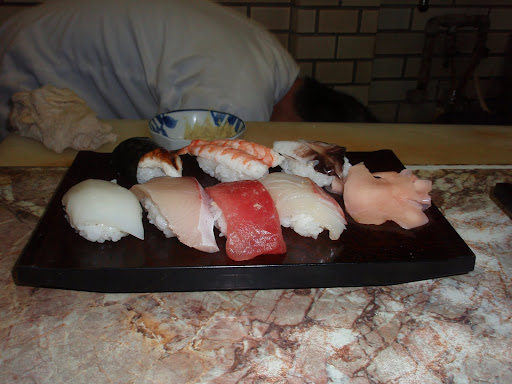
On Saturday I went once again, with 2 people from hy home (both Germans), to this ingenious Sushi and Sashimi Restaurant, which I already visited together with David in the summer.
The food is just delightful and incredibly cheap (even by Japaneses standards). We ate for nearly two hours, drank two bottles of good Sake and one beer and everyone of us paid only 12 Euro. FANTASTIC!
The main part of the work is done by the Father, who can only walk ducked (you notice he's preparing food for decades), while the son aids him and talks with the guests. The eatery itself lies hidden in some side street und looks a little bit rundown, but the fish is fresh every evening and really great.

The son recognized me and even remembered that I'm Austrian. *he he*
Then again, the eatery has only room for a max of 6 (!) people.


Today (2nd Monday in October) is the day of Sport and Health in Japan, a national holiday. Therfore a friend and I (Mikael) have decided to go hiking to the highest peak of the Rokko Mountain Range. Out of convinience most times the peak is just called "Mount Rokko" (六甲) (although to the trained Austrian 931 meters is a hill not a mountain). Rokko is more or less the local mountain (local mountain range) of Kôbe and favoured for its beauty.

But we had to scrap our plan, since, although the last days it was always clear and hot, of all things it rained all day long. Well, another time then.


Interesting (and funny) facts/opinions about Japan:


The by far most important means of public transportation in Japan are the trains. (電車 densha). Aside from Tokyo (edit. and Osaka) the subway (地下鉄 chikatetsu) lives a shadowy existence and many times is even outclassed by the buses. Incidentally Hiroshima is the only town with a tramway.
The delightful thing with this concept is the fact that the trains are nearly always precisely on time: If the board display "Departure: 17:08 o'clock", well you better be sitting in the train at 17:08 or else its gone, however it doesn't leave one minute before either. Such a refreshing difference compared to the ÖBB (National Train Company of Austria).
One fact is confusing the first few times: There's not one train line but thousands and thousands of them and nearly all are independent from each other and parts of different companies. In spite of that they all cooperate perfectly, the harmonise in a manner of speaking.
Must be because of Japanese society. "We are one, Perfection is our aim, Resistance is futile".

In the next issue of our column, we're gonna write more about the train system and the behaviour on the trains.

Monday, 24 March 2008

Finally back here! (yeeha)

Original Posting Date: Saturday, October 6th 2007


Sooo ...

After nearly two weeks I finally found the time (and the Internet), to actually write something on my blog. Contrary to several requests I still decided to upload several pictures on this site, because there are simply too many pictures in my albums and the links to those would be too uncomfortable for my readers.

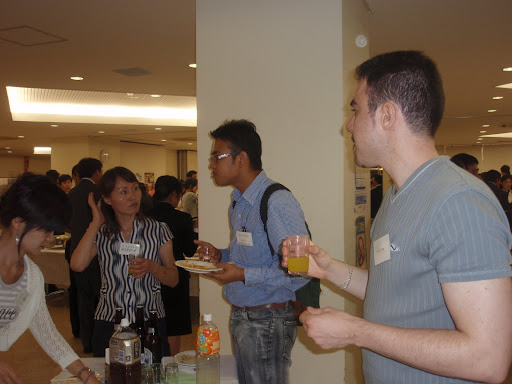
The first week proceeded without any major events, I just reacquainted myself with the city, went a few times to University and otherwise just enjoyed time here. Afterwards I was invited to the International Students Homecoming Day and the Global Career Seminar. It was quite interesting and the buffet really good.


I stayed at the same hotel as in the summer during the "Kobe University Summer Program in Japanese Language and Culture" (the report about this will be handed in later) (edit: way later as I know now).
Well, I have seen bigger shoeboxes than the rooms in the hotel, although those aren't even the smallest, the smallest one can find in the so-called capsule-hotels.
Despite that it was comfortable and first and foremost every room has an airconditioning device, which was really needed with temperatures still as high as 30 degrees Celsius (86°F). (By the way, there are hardly any rooms in Japan which are not airconditioned)


That's it for now, I have to go back to studying, but I hope, starting from now my entries come on a more regular basis and all the readers (all 5 of you) are going to give comments once in a while.


And now our daily column

Interesting (and funny) facts/opinions about Japan:

Japanese people are (especially here in the Kansai Region) very polite and nice to foreigners. You can't stand around for two minutes with an opened city-map without someone immediately asking if you need help. Of course often it is a little bit difficult, since many Japanese can't really speak English that well, thus one hardly gets relevant infos or real help, still it's the thought that counts.

Many Japanese are akin to the French when it comes to the language. If they notice you can speak a little bit of Japanese, they try to avoid speaking a single English word as good as it gets.
The difference: French are doing it because they think their language is the only true one in the world; Japanese are doing it because the have a kind of inborn fear of the English. Furthermore the might think they loose their face if the don't speak perfectly, they may could say something inappropriate (which just shows their politeness even more).

Prologue

Original Posting Date: Saturday October 6th 2007


So. I am back again after all.
In this country, in this place to which I set forth months ago to conquer it, just to be forced to leave it just after 3 weeks.
I was defeated and couldn't fulfil my assignment ...

My supervisors from the "institution" were very disgruntled and forgot my achievements and accomplishments and started to judge over me. Finally, as punishment it was decided to banish me, ironically (or cruelly?) to the place of my failure.

Thus I ended up here, marooned ...
Who I am, you ask?
I am Manuel Leitgeb, once acclaimed hero of countless achievements in various disciplines, with many a melodius name, and now, now MAROONED IN JAPAN.

This is my story ...

Sunday, 23 March 2008

Introduction

To my people:
(Austrian Kaiser reference)

I finally managed to start translating my Blog about my time in Japan from German to English and yes, it took nearly my whole time here. Which means that the entries are roughly 6 months behind the entry date on my original blog, so for your convenience, and to minimise confusion, I include the orginal posting date at the beginning of each entry.
The translation will be one to one as far as possible, although I might add minor things to clarify some issues you might not know because you are not an Austrian or a German-speaking reader or because something has changed since the original posting. These additions will be marked as "edit:"

Comments and criticism of any kind are very much welcome, especially when it comes to things about Japanese life, culture and customs. If you find a mistake please write a comment about it, so that I can correct it, after all, I don't want to give readers the wrong impressions or tell wrong facts about this lovely country (this request is especially directed to Japanese readers, after all you're the experts, right? ;).

Anyway my friends, take care and please enjoy the show.